Chapter 3
Magnetic Fields and Inductors
3.1 Magnetic force
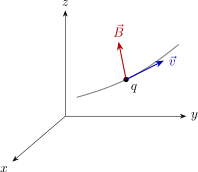
Magnetic force arises when charges move. The force on a charge \(q\) moving with velocity \(\vb v\) in a magnetic field \(\vb B\) is \[\begin{equation} \tag{3.1} \keyeq{\vb F_m = q\,\vb v\times\vb B} \end{equation}\] This is the Lorentz force.
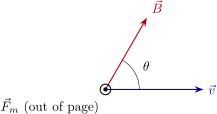
Its magnitude is \[\keyeq{F_m = q\,v\,B\sin\theta}\] where \(\theta\) is the angle between \(\vb v\) and \(\vb B\). The direction is given by the right-hand rule (RHR).
Note: \(\vb F_m \perp \vb v\), so the magnetic force is a deflecting force.
Special case: circular motion
If \(\vb v\perp\vb B\) then \(\theta = \pi/2\) and \[\keyeq{F_m = q\,v\,B}\]
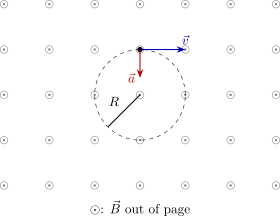
Newton’s second law, \(\vb F_m = m\vb a\), with circular motion, \(a = v^2/R\), gives \(F_m = m v^2/R\). Hence \[\frac{m v^2}{R} = q\,v\,B \quad\Longrightarrow\quad \keyeq{\displaystyle R = \frac{m\,v}{q\,B}}\]
Force on a current-carrying wire
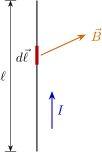
The force on a wire in a field \(\vb B\) follows from summing the Lorentz force over the moving charges. For a small element \(d\vb\ell\) of the wire, where \(\vb\ell\) is a vector pointing along the wire, \[\begin{align*} d\vb F_m &= dQ\,\frac{d\vb\ell}{dt}\times\vb B = \frac{dQ}{dt}\,d\vb\ell\times\vb B \\ &\;\boxed{\;= I\,d\vb\ell\times\vb B\;} \end{align*}\]
For a constant field \(\vb B\), \[\keyeq{\displaystyle \vb F_m = \int_{\text{wire}} d\vb F_m = I\left(\int_{\text{wire}} d\vb\ell\right)\times\vb B = I\,\vb\ell\times\vb B}\]
Example: current loop (motor)
A rectangular loop carrying current \(I\) can rotate about the \(x\)-axis in a uniform field \(\vb B = B\,\uv\jmath\). The sides have lengths \(a\) (sides 1 and 3) and \(b\) (sides 2 and 4). Tilted by an angle \(\theta\) from the \(z\)-axis (right panel: the loop seen along the \(x\)-axis), the forces are:
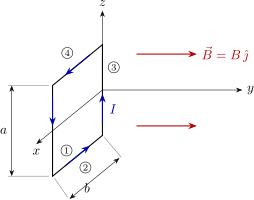
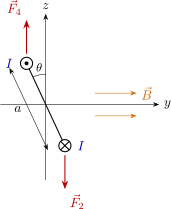
\[\keyeq{\vb F_1 = I\,a\,B\cos\theta\;\uv\imath = -\vb F_3} \qquad\text{(cancel)}\] \[\keyeq{\vb F_2 = I\,b\,B\,(-\uv k) = -\vb F_4}\] and these rotate the coil back to the \(z\)-axis.
3.2 Magnetic sources
Moving charges source \(\vb B\)-fields.
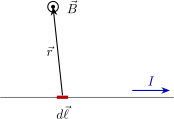
\[\begin{equation} \tag{3.2} \keyeq{\displaystyle d\vb B = \frac{\mu_0}{4\pi}\,\frac{I\,d\vb\ell\times\uv r}{r^2}} \end{equation}\] This is the Biot–Savart law, where \(\mu_0\) is the permeability of free space. Compare with Coulomb’s law and \(\varepsilon_0\).
Long wire
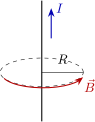
\[\keyeq{\displaystyle B = \frac{\mu_0}{2\pi}\,\frac{I}{R}}\] The direction is given by the RHR. (This requires doing the integral of the Biot–Savart law along the wire.)
Solenoid
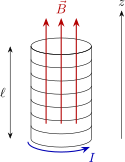
Inside a solenoid of length \(\ell\) with \(N\) loops, \[\begin{equation} \tag{3.3} \keyeq{\displaystyle \vb B = \frac{\mu_0\,N\,I}{\ell}\;\uv k} \end{equation}\]
3.3 Faraday’s law and inductance
Faraday’s law: changing \(\vb B\) sources \(\vb E\).
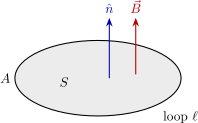
The magnetic flux through a surface \(S\) (area \(A\), unit normal \(\uv n\)) bounded by a loop \(\ell\) is \[\keyeq{\Phi_m = \vb A\cdot\vb B}\] when \(\uv n\parallel\vb B\) and both are constant. The flux \(\Phi_m\) is roughly the number of field lines “cut” by the surface.
The voltage around the loop \(\ell\) is \[\begin{equation} \tag{3.4} \keyeq{\displaystyle \mathcal{E} = -\frac{d\Phi_m}{dt}} \end{equation}\]
Double solenoid
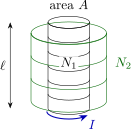
A current \(I\) through an inner solenoid (\(N_1\) turns, length \(\ell\), area \(A\)) induces a voltage in an outer wire wound with \(N_2\) turns. By (3.4) and (3.3), \[\begin{align*} \mathcal{E} &= -N_2\frac{d\Phi_m}{dt} = -N_2\frac{d}{dt}(AB) \\ &= -N_2 A\,\frac{d}{dt}\!\left(\frac{\mu_0 N_1 I}{\ell}\right) \end{align*}\]
\[\begin{equation} \tag{3.5} \mathcal{E} = -\underbrace{\mu_0\,\frac{N_1 N_2 A}{\ell}}_{\keyeq{M}}\,\frac{dI}{dt} \end{equation}\] The coefficient \(M\) is the mutual inductance.
Self-inductance
Changing magnetic fields inside the solenoid induce a voltage that resists the changing current. For a single solenoid, replace \(N_2 = N_1 = N\): \[\mathcal{E} = -\underbrace{\mu_0\,\frac{N^2 A}{\ell}}_{L}\,\frac{dI}{dt},\] where \(L\) is the inductance. In general, \[\begin{equation} \tag{3.6} \keyeq{\displaystyle \mathcal{E}_L = -L\,\frac{dI}{dt}} \end{equation}\]
Problems
Problems are taken from the sources listed under Sources and Attribution. Numbers refer to the end-of-chapter problems; figures have been redrawn.
OpenStax University Physics Vol. 2, Chapter 11: Magnetic Forces and Fields
11.21
(a) Aircraft sometimes acquire small static charges. Suppose a supersonic jet has a \(0.500\,\mathrm{\mu C}\) charge and flies horizontally at a speed of \(660.\,\mathrm{m/s}\) over Earth’s south magnetic pole (near the north geographic pole), where the \(8.00\times 10^{-5}\,\mathrm{T}\) magnetic field points straight down into the ground. What are the direction and the magnitude of the magnetic force on the plane? (b) Discuss whether the value obtained in part (a) implies this is a significant or negligible effect.
11.27
(a) An oxygen-16 ion with a mass of \(2.66\times 10^{-26}\,\mathrm{kg}\) travels at \(5.0\times 10^{6}\,\mathrm{m/s}\) perpendicular to a \(1.20\,\mathrm{T}\) magnetic field, which makes it move in a circular arc with a \(0.231\,\mathrm{m}\) radius. What positive charge is on the ion? (b) What is the ratio of this charge to the charge of an electron? (c) Discuss why the ratio found in (b) should be an integer.
11.35
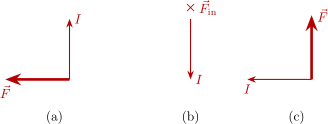
What is the direction of the magnetic field that produces the magnetic force shown on the currents in each of the three cases, assuming \(\vb B\) is perpendicular to \(I\)?
11.37
(a) A dc power line for a light-rail system carries \(1000\,\mathrm{A}\) at an angle of \(30.0^\circ\) to Earth’s \(5.0\times 10^{-5}\,\mathrm{T}\) field. What is the force on a \(100\,\mathrm{m}\) section of this line? (b) Discuss practical concerns this presents, if any.
11.53
A physicist is designing a cyclotron to accelerate protons to one-tenth the speed of light. The magnetic field will have a strength of \(1.5\,\mathrm{T}\). Determine (a) the rotational period of the circulating protons and (b) the maximum radius of the protons’ orbit.
OpenStax University Physics Vol. 2, Chapter 12: Sources of Magnetic Fields
12.27
The accompanying figure shows two long, straight, horizontal wires that are parallel and a distance \(2a\) apart. If both wires carry current \(I\) in the same direction, (a) what is the magnetic field at \(P_1\)? (b) \(P_2\)?
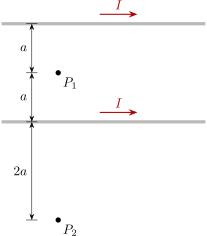
12.28
Repeat the calculations of the preceding problem with the direction of the current in the lower wire reversed.
12.55
A solenoid with 25 turns per centimeter carries a current \(I\). An electron moves within the solenoid in a circle that has a radius of \(2.0\,\mathrm{cm}\) and is perpendicular to the axis of the solenoid. If the speed of the electron is \(2.0\times 10^{5}\,\mathrm{m/s}\), what is \(I\)?
OpenStax University Physics Vol. 2, Chapter 14: Inductance
14.31
A coil of 40 turns is wrapped around a long solenoid of cross-sectional area \(7.5\times 10^{-3}\,\mathrm{m^2}\). The solenoid is \(0.50\,\mathrm{m}\) long and has 500 turns. (a) What is the mutual inductance of this system? (b) The outer coil is replaced by a coil of 40 turns whose radius is three times that of the solenoid. What is the mutual inductance of this configuration?
14.39
A coil with a self-inductance of \(2.0\,\mathrm{H}\) carries a current that varies with time according to \(I(t) = (2.0\,\mathrm{A})\sin 120\pi t\). Find an expression for the emf induced in the coil.
14.43
A long, cylindrical solenoid with 100 turns per centimeter has a radius of \(1.5\,\mathrm{cm}\). (a) Neglecting end effects, what is the self-inductance per unit length of the solenoid? (b) If the current through the solenoid changes at the rate \(5.0\,\mathrm{A/s}\), what is the emf induced per unit length?