Chapter 4
Oscillations
This chapter has three objectives:
understand the damped oscillator;
learn to solve linear, homogeneous differential equations;
use trigonometric identities to rearrange formulas.
4.1 Recall: the RC circuit
For the discharging capacitor, (2.3) reads (with a dot for \(d/dt\)) \[\dot Q(t) = -\frac{1}{RC}\,Q(t).\] Guess an exponential, \(Q(t) = Q_0\,e^{\lambda t}\). Substituting gives \[\keyeq{\displaystyle \lambda = -\frac{1}{RC}} \qquad\therefore\qquad \keyeq{\displaystyle Q(t) = Q_0\,e^{-t/RC}}\]
4.2 Simple harmonic oscillator
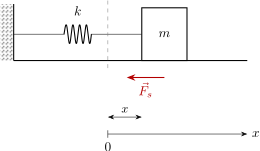
A mass \(m\) on a spring of spring constant \(k\). The spring exerts the force \[\keyeq{F_s = -k\,x}\] (Hooke’s law), where \(x\) is the displacement from the equilibrium position.
Equation of motion
Newton’s second law, \(F = ma\) with \(F = F_s\), gives \(ma = -kx\), that is \[\begin{equation} \tag{4.1} \keyeq{\displaystyle \frac{d^2x}{dt^2} + \frac{k}{m}\,x = 0} \end{equation}\] This is a second-order differential equation.
Solution
Use the same strategy as for the RC circuit. Guess \(x(t) = A\,e^{\lambda t}\), so \[\frac{dx}{dt} = \lambda A\,e^{\lambda t}, \qquad \frac{d^2x}{dt^2} = \lambda^2 A\,e^{\lambda t}.\] Plugging into (4.1) gives \(\lambda^2 x + \dfrac{k}{m}\,x = 0\), so \[\keyeq{\displaystyle \lambda = \pm\sqrt{-\frac{k}{m}}}\] There are two solutions (two derivatives), and \(\sqrt{-1} = i\) is imaginary! Call \(\lambda = i\omega\), with \[\omega = \sqrt{\frac{k}{m}} .\] Then \[\begin{equation} \tag{4.2} \keyeq{x(t) = A\,e^{+i\omega t} + B\,e^{-i\omega t}} \end{equation}\] which we call Form 1. How do we interpret it?
Euler’s formula
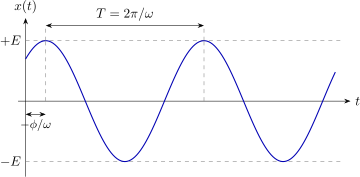
Use Euler’s formula \[\keyeq{e^{i\omega t} = \cos\omega t + i\sin\omega t}\] Then \[\begin{align*} x(t) &= A\,(\cos\omega t + i\sin\omega t) + B\,(\cos\omega t - i\sin\omega t) \\ &= \underbrace{(A+B)}_{\equiv\, C}\cos\omega t + \underbrace{i\,(A-B)}_{\equiv\, D}\sin\omega t \end{align*}\] \[\begin{equation} \tag{4.3} \keyeq{x(t) = C\cos\omega t + D\sin\omega t} \end{equation}\] which is Form 2. Here \(\omega\) is the angular frequency of the oscillations, and \(C\), \(D\) are set by the initial conditions. Why? Because \[\keyeq{x(t=0) = C} \qquad v(t) = -C\omega\sin\omega t + D\omega\cos\omega t \;\Longrightarrow\; \keyeq{v(t=0) = D\,\omega}\]
Frequency and period
\[\omega = 2\pi f, \qquad T = \frac{1}{f} = \frac{2\pi}{\omega},\] where \(f\) is the frequency of the oscillations and \(T\) the period.
One more identity
Use \(\cos(a+b) = \cos a\cos b - \sin a\sin b\): \[E\cos(\omega t + \phi) = \underbrace{(E\cos\phi)}_{\equiv\, C}\cos\omega t - \underbrace{(E\sin\phi)}_{\equiv\, D}\sin\omega t .\] Note that \[\keyeq{C^2 + D^2 = E^2\cos^2\phi + E^2\sin^2\phi = E^2} \qquad \keyeq{\displaystyle -\frac{D}{C} = \frac{\sin\phi}{\cos\phi} = \tan\phi}\] Therefore \[\begin{equation} \tag{4.4} \keyeq{x(t) = E\cos(\omega t + \phi)} \end{equation}\] which is Form 3: a shifted oscillating function with amplitude \(E\).
4.3 Damped oscillator
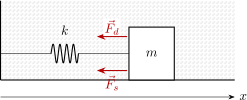
A box in a damping medium (e.g. air). There is now a damping force \[\keyeq{\vb F_d = -b\,\vb v}\] where \(b\) is the damping coefficient.
Newton’s second law, \(ma = -kx - bv\), gives \[\begin{equation} \tag{4.5} \keyeq{\displaystyle m\,\frac{d^2x}{dt^2} + b\,\frac{dx}{dt} + k\,x = 0} \end{equation}\]
Solution
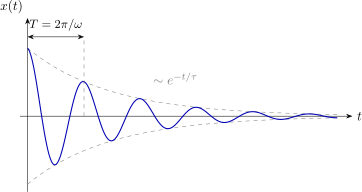
Guess \(x(t) = A\,e^{\lambda t}\). Then (4.5) becomes \(m\lambda^2 + b\lambda + k = 0\), so \[\lambda = -\frac{b}{2m} \pm \sqrt{\left(\frac{b}{2m}\right)^2 - \frac{k}{m}} .\] Call \[\tau = \frac{2m}{b}, \qquad \omega_0 = \sqrt{\frac{k}{m}} .\] Then if \(\omega_0^2 > 1/\tau^2\) the square root is imaginary and \[\begin{align*} x(t) &= e^{-t/\tau}\left(A\,e^{i\omega t} + B\,e^{-i\omega t}\right) &&\text{(Form 1)} \\ &= \keyeq{E\,e^{-t/\tau}\cos(\omega t + \phi)} &&\text{(Form 3)} \end{align*}\] where \[\omega = \sqrt{\frac{k}{m} - \left(\frac{b}{2m}\right)^2} .\] This is a damped oscillator.
Problems
Problems are taken from the sources listed under Sources and Attribution. Numbers refer to the end-of-chapter problems; figures have been redrawn.
OpenStax University Physics Vol. 1, Chapter 15: Oscillations
15.29
A mass \(m_0\) is attached to a spring and hung vertically. The mass is raised a short distance in the vertical direction and released. The mass oscillates with a frequency \(f_0\). If the mass is replaced with a mass nine times as large, and the experiment was repeated, what would be the frequency of the oscillations in terms of \(f_0\)?
15.39a
A novelty clock has a \(0.0100\,\mathrm{kg}\)-mass object bouncing on a spring that has a force constant of \(1.25\,\mathrm{N/m}\). What is the maximum velocity of the object if the object bounces \(3.00\,\mathrm{cm}\) above and below its equilibrium position?
15.59
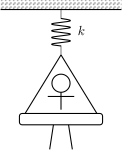
The device pictured in the figure entertains infants while keeping them from wandering. The child bounces in a harness suspended from a door frame by a spring. (a) If the spring stretches \(0.250\,\mathrm{m}\) while supporting an \(8.0\,\mathrm{kg}\) child, what is its force constant? (b) What is the time for one complete bounce of this child? (c) What is the child’s maximum velocity if the amplitude of her bounce is \(0.200\,\mathrm{m}\)?
15.67a
A \(2.00\,\mathrm{kg}\) block lies at rest on a frictionless table. A spring, with a spring constant of \(100\,\mathrm{N/m}\) is attached to the wall and to the block. A second block of \(0.50\,\mathrm{kg}\) is placed on top of the first block. The \(2.00\,\mathrm{kg}\) block is gently pulled to a position \(x=+A\) and released from rest. There is a coefficient of friction of 0.45 between the two blocks. What is the period of the oscillations?
OpenStax Calculus Vol. 3, Chapter 7: Second-Order Differential Equations
7.93a
An \(800\,\mathrm{lb}\) weight (25 slugs) is attached to a vertical spring with a spring constant of \(226\,\mathrm{lb/ft}\). The system is immersed in a medium that imparts a damping force equal to 10 times the instantaneous velocity of the mass. Find the equation of motion if it is released from a position \(20\,\mathrm{ft}\) below its equilibrium position with a downward velocity of \(41\,\mathrm{ft/s}\).
(Note: take \(m = 800\,\mathrm{lb}/g\), where \(g = 32\,\mathrm{ft/s^2}\).)